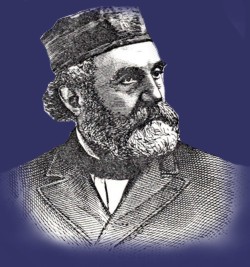
Collis P. Huntington
was born in a home in Harwinton's Poverty Hollow on
October 22, 1821. When he reached 14 years of age he
was already working and, at the age of 28, he set out
for the California gold fields. In 1861, while the Civil
War was getting underway, he, along with partners Mark
Hopkins, Leland Stanford and the Crocker Brothers, incorporated
the Central Pacific Railroad of California. He secured
government land grants and attained financial aid to
build a rail line from the Pacific coast to a meeting
place with the Union Pacific. Later he focused his attention
to the building of the Southern Pacific Railroad which
was nearly 10,000 miles in total length.
He was, without
question, one of the greatest men our country produced,
not only because of the vast amount of money he made
(he left a $75 million estate) but by reason of his
tremendous service to the country as a builder of railroads.
He knew how to earn, save, spend money wisely and how
to make things happen. According to Charles E. Russell,
"C.P. Huntington was the greatest railroad genius
of his time and one of the greatest masters of transportation
in the world."
In his early years
he helped his father at the Poverty Hollow farm and
in the mill they ran. In the wintertime he attended
the Poverty Hollow School. Miss Eli, his teacher at
the school once reported that "Collis was very
poorly clothed, and not well cared for, as the family
was in dire circumstances." Finally, his father
could no longer meet the payments required to maintain
the farm and moved his family to a small house more
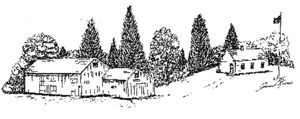
towards the center of town. Here he attended the Center
Schoo,l now restored and maintained by the Harwinton
Historical Society.
In 1834 the Huntington
family became so poor and destitute that the Harwinton
selectmen removed Collis and his oldest brother, Solon,
from the Harwinton home in order to improve the condition
and relieve the family. This event would remain with
Collis all of his life and he made a comment, 53 years
later at the dedication of his chapel, that would indicate
that his memory was unforgiving. (See Footnote at end
of this story)
He was placed on
the Orson Barber farm in the Clearview District and
attended the Clearview School for about four months,
the last four months that he would ever attend school.
With a small savings
he started a clock business. In 1842 he entered into
partnership with Solon, in the general merchandise business
at Oneonta New York. He left for the sunny shores of
California six years later. In Sacramento he began a
business selling mining implements from under a tent
to the forty-niners. A store soon followed. This hardware
store was called Hopkins and Huntington, named, in part,
for his newly found friend and partner Mark Hopkins.
This store would prosper for 24 years.
So how in
the world did he get involved with railroad building?
Theodore D. Judah, another Connecticut born entrepreneur
went to California in May of 1854. Not a single railroad
track was in place west of the Rocky Mountains at that
time. He started laying track for the Sacramento Valley
Railroad in 1855 after providing a survey. He next was
asked to survey a wagon road over the Sierra Nevada
Mountains all the way to the Nevada silver mines. This
route is still in place today as a well traveled road.
It was Judah who spawned the idea to run a railroad
over the mountains heading east and became so obsessed
with the idea people began to refer to him as "Crazy
Judah". He made numerous attempts to solicit businessmen
to assist with the required finances to fund such an
endeavor. Finally, in Sacremento, he held a meeting
with about twelve business men in a little office upstairs
in a building housing the Hopkins and Huntington hardware
store. The men in attendance included Leland Sanford,
Mark Hopkins, Charles Crocker and Collis P. Huntington.
It was at this meeting that funding was acquired and
on June 28, 1861, the formation of the Central Pacific
Railroad Company of California occurred.