|
The
Flood of 1867
To most of our Harwinton residents the
flood of 1955 was the only flood that this area has
ever experienced. While it stands today as the most
significant, it by no means, is the only flood that
has affected Harwinton.
The storm that dumped huge amounts of rain on our town
on September 6th, 1867, was impressive to say the least.
W. A. Birden, in about the year 1900, recalled this
storm and this is some of what he shared back then.
He said he was 19 yrs old that year and on the fateful
day he was cutting brush at his father’s farm,
located about 1 mile west of Lead Mine Brook and near
a tributary of the same brook which flowed from Catlin’s
pond. (This pond was where Lake Harwinton currently
is located). It was about 4:00 in the afternoon.
He described the cloud burst and how soaked he became
in minutes as “As if he had fallen into the river”.
He added that “The clouds literally poured water
and made him gag for breath like a drowning man”
as he hastened home. Water ran down the hillsides, not
in rivulets or streams, but in sheets of water. Within
hours all the low lying fields were completely under
water.
Later, when the storm had abated, He walked down to
the Lead Mine Brook Bridge to see the effects of the
storm. He found that the little Lead Mine Brook, which
nearly runs dry in summer, had become a raging river
“a full 12 rods wide”. The water had reached
the pile of rocks at the M. L. Goodwin farm (Frank Rybek’s
place) on the west side, right up to the one room schoolhouse
on the east side. The bridge was completely gone.
There had been a funeral that afternoon in the west
side of town with burial in the east cemetery. The returning
members of the procession were caught in the storm and
put their teams in the horse sheds behind the Congregational
Church and some spent the night in the Post Office (Charter
Oak Farm).
The grave digger lived in the west side and he was the
last to make it across the bride. He waded through two
feet of water to cross it. He said later that planks
were already missing as he crossed. Once on the other
side, he saw the disintegrating bridge “Rise up
and float away like a boat”. It lodged in the
bushes at the curve in the stream one half mile to the
south. Some of the timbers were retrieved from this
location and used to construct the new bridge.
The next morning he and some others again went down
to the brook at the bottom of center hill and found
that the water had subsided to nearly its normal level.
He asked the crowd to assist him in placing some poles
from a broken railing across the stream, on the rocks
between the abutments of the bridge. In a short time
these poles and a few boards provided a means to cross
the brook until a new bridge was in place a few weeks
later. In the mean time, teams had to cross the brook
a little north of the bridge by driving them through
the water. He described the effects of the rushing water
on the banks as “Turf on the banks was turned
over as if by a plow”.
George Bentley was living on the Abijah Catlin farm
and had been in Torrington with a pair of horses that
afternoon. On his return trip he was caught in the storm.
He crossed the first bridge near the Albert Wilson farm
safely. (Area of Woodland Drive) As he headed farther
down the road he actually saw the flood coming and whipped
up his horses hoping to reach the next bridge before
the flood of water did. He tried to cross but the current
was so strong across the bridge that it washed him and
his team right off the bridge. Mr. Bentley succeeded
in getting his team ashore but the wagon cushions and
some paraphernalia were washed downstream. He made his
way up the hill to the home of Capt. Roswell Cook (Truman
Kellogg House) where he put out his team and stayed
the night. Before retiring he walked back down the hill
to where the bridge had been and shouted to the crowd
gathered on the other side to go tell his wife he was
alright. The brook was now so wide and so noisy that
the crowd could not make out what he was asking. The
next day he crossed the foot bridge and went home, was
taken sick and became delirious from the exposure and
fright that he had had. (according to W. A. Birden)
A frame bridge on the farm of C. S. Barber was also
washed away. (The farm was located below the swimming
hole) Cyrus Barber said that he measured the rise of
the stream and that it rose two feet in 5 minutes. He
had a patch of potatoes on the side of the stream, and
it with its crop was washed away. The next day he went
across the stream and picked up thirteen bushels of
potatoes from the grass and bushes. “We think
this was the worst flood that the Lead Mine Brook Valley
has ever seen” was how he summed it all up.
The Railroad Bridge, located five miles to the west,
was “wrecked”. It must have taken months
to restore railroad service.
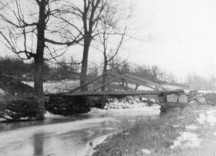
The "replacement" Bridge
at Cyrus Barbers
Photo circa 1900
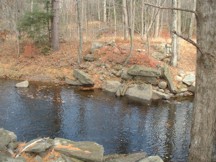
Where the bridges were at Cyrus
Barber's Farm
As it looks today (2008)
Source: Von Tobel
Scrapbooks
|